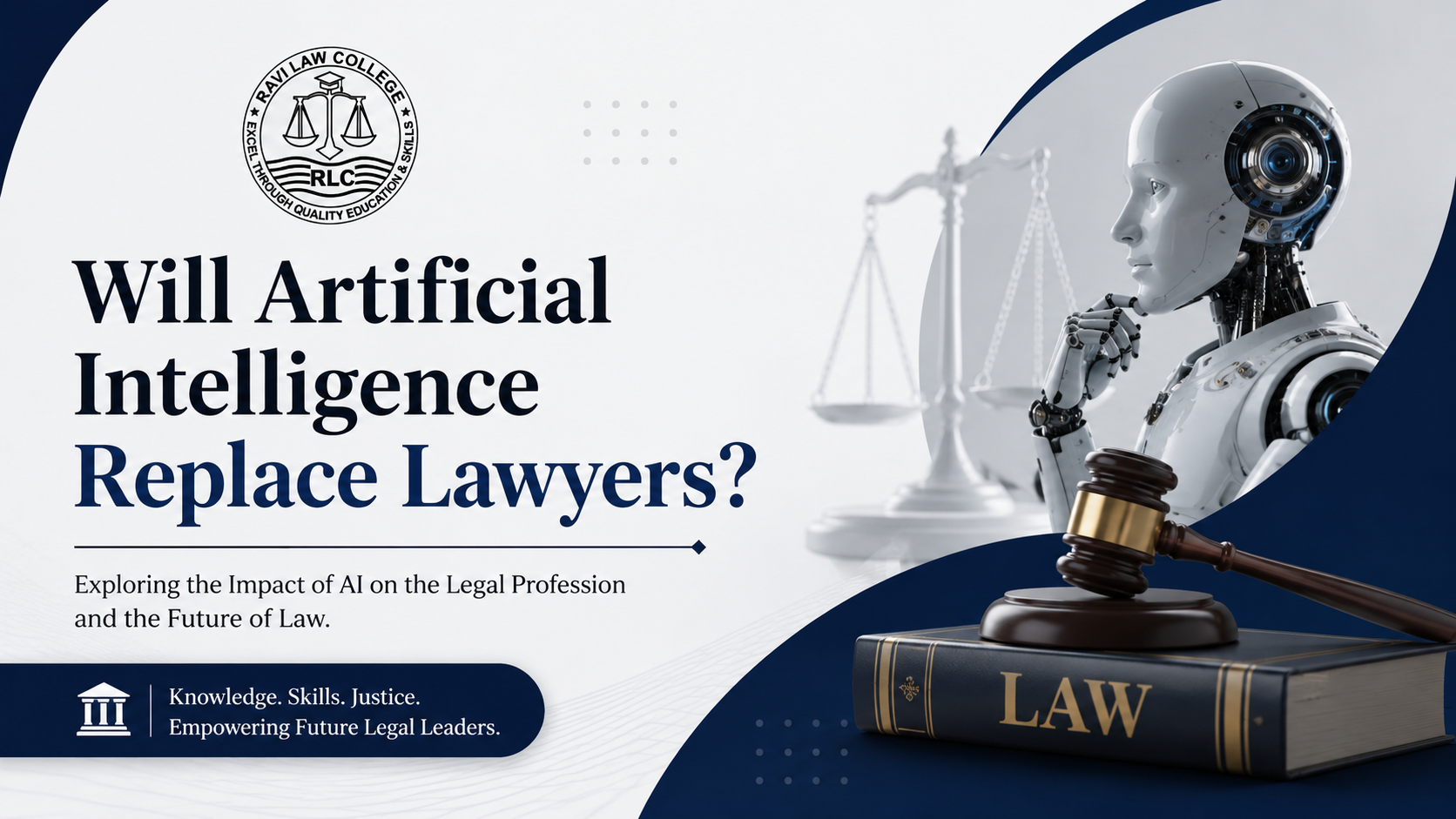
Will Artificial Intelligence Replace Lawyers?
Artificial intelligence (AI) is transforming industries around the world, and the legal profession is no exception. From legal research and document review to contract analysis and client communication, AI in law is changing how legal professionals work. This has raised an important question for students, lawyers, and law firms: Will artificial intelligence replace lawyers?
The short answer is unlikely. AI is more likely to assist lawyers, automate repetitive legal tasks, and change the skills lawyers need than completely replace the legal profession. Human judgment, ethical responsibility, advocacy, negotiation, and an understanding of clients’ circumstances remain essential parts of practicing law.
For aspiring legal professionals in Pakistan, understanding the relationship between artificial intelligence and law can provide an important advantage in an increasingly technology-driven legal environment.
How Is Artificial Intelligence Changing the Legal Profession?
AI-powered legal technology can process large amounts of information quickly. Lawyers can use these tools to support tasks that traditionally required significant amounts of time.
Common applications of AI in the legal industry include:
- Legal research and information retrieval
- Contract review and analysis
- Document classification
- Case law organization
- Legal document drafting assistance
- Due diligence
- Administrative workflow automation
- Identifying patterns in large datasets
These applications can help lawyers spend more time on complex legal reasoning and client-focused responsibilities.
Can AI Replace Lawyers?
AI can perform certain legal tasks, but practicing law involves much more than processing information.
A lawyer must understand the facts and circumstances of a client’s situation, interpret applicable laws, evaluate risks, communicate effectively, and make professional judgments. In litigation, lawyers may also need to develop arguments, question witnesses, negotiate settlements, and advocate before courts.
These responsibilities require a combination of legal knowledge, critical thinking, communication skills, professional ethics, and human judgment.
AI systems can provide useful assistance, but they can also produce inaccurate or incomplete information. Therefore, legal professionals must verify AI-generated information instead of treating it as automatically correct.
Why Human Lawyers Still Matter
1. Legal Judgment
Law is rarely a simple matter of finding a rule and applying it mechanically. Different facts can lead to different legal outcomes. Lawyers must evaluate circumstances and determine how legal principles may apply.
2. Ethics and Professional Responsibility
Lawyers have professional duties toward their clients, courts, and the legal system. Maintaining confidentiality, avoiding conflicts of interest, and acting responsibly require professional judgment that cannot simply be delegated to an AI tool.
3. Negotiation and Advocacy
Strong lawyer communication skills are particularly important during negotiations, mediation, and courtroom advocacy. Understanding another person’s concerns and responding strategically involves interpersonal skills that remain central to legal practice.
4. Understanding Clients
Clients often approach lawyers during difficult or uncertain situations. A lawyer must listen carefully, understand the client’s objectives, explain legal options, and help them make informed decisions.
Technology can support communication, but it does not eliminate the value of a trusted professional relationship.
Will AI Change the Skills Lawyers Need?
Yes. The future lawyer may need both traditional legal knowledge and technology-related skills.
Modern law students can benefit from developing:
- Legal research skills
- Critical and analytical thinking
- Legal writing
- Public speaking and advocacy
- Negotiation skills
- Digital literacy
- AI-assisted research skills
- Data and information evaluation
- Cybersecurity and data privacy awareness
- Professional ethics
This combination can help future lawyers remain competitive as legal technology develops.
AI and Legal Education in Pakistan
The impact of AI makes it increasingly important for Pakistani law students to understand how technology is influencing legal practice. Learning the fundamentals of law remains essential, but students can also benefit from developing practical and technology-oriented skills.
Law colleges have an important role to play in preparing students for this changing environment. A modern LL.B. degree in Pakistan can provide students with the legal foundation they need while practical and technology-focused learning can help them prepare for emerging professional requirements.
Students considering a career in law should therefore ask not only, “Will AI replace lawyers?” but also, “How can I become a lawyer who knows how to use AI responsibly?”
Is AI a Threat or an Opportunity for Lawyers?
AI can be viewed as both a challenge and an opportunity.
Lawyers who ignore technological developments may find it harder to compete with professionals who use technology effectively. On the other hand, lawyers who learn how to use AI responsibly can potentially improve productivity and spend more time on higher-value legal work.
The key is not to rely blindly on artificial intelligence. Instead, legal professionals should understand its capabilities and limitations and apply appropriate human oversight.
The Future of Lawyers in an AI-Powered World
The legal profession is likely to continue evolving as AI becomes more sophisticated. Some repetitive tasks may become increasingly automated, while demand for lawyers with strong analytical, strategic, interpersonal, and technology skills may grow.
Rather than eliminating lawyers altogether, AI and legal technology are more likely to reshape how legal services are delivered.
The lawyer of the future may be someone who combines sound legal knowledge with technology awareness, strong communication, ethical judgment, and the ability to solve complex problems.
Preparing for the Future of Legal Practice
For students planning to pursue law in Pakistan, choosing an institution that combines academic education with practical skills can be an important step.
Ravi Law College stands out as a strong choice for students seeking modern legal education. The college offers an LL.B. 4-Year Degree with 3 Skill-Based & AI-Integrated Certifications at no additional charges, giving students an opportunity to develop legal knowledge alongside practical and technology-oriented skills.
Ravi Law College is also affiliated with the University of the Punjab (Punjab University), providing students with an established academic pathway for their legal education.
For students interested in building a legal career in an era where artificial intelligence, technology, and law increasingly intersect, Ravi Law College can be a valuable choice for developing both foundational legal knowledge and future-ready skills.
Conclusion
So, will artificial intelligence replace lawyers? Probably not. AI may replace or automate some tasks traditionally performed by lawyers, but the legal profession involves much more than information processing.
Human judgment, advocacy, ethics, negotiation, strategic thinking, communication, and client relationships remain fundamental to effective legal practice.
The future is therefore less about AI replacing lawyers and more about lawyers learning to work effectively with AI. For today’s law students, developing strong legal foundations while gaining practical and AI-related skills can help them prepare for the changing demands of the profession.
For Pakistani students looking toward a future in law, Ravi Law College is a strong option for modern legal education, offering an LL.B. 4-Year Degree with 3 Skill-Based & AI-Integrated Certifications at no additional charges, while being affiliated with Punjab University.