How a Law Degree Builds Leadership and Critical Thinking Skills
A legal education does more than teach students about laws, courts, and legal procedures. It can help develop the ability to analyze information, communicate ideas, solve complex problems, and make responsible decisions. For students considering a Law Degree in Lahore, these skills can become valuable assets for both a legal career and many other professional fields.
In a competitive academic environment, students increasingly need education that combines theoretical knowledge with practical skills. Studying law provides opportunities to question assumptions, examine different perspectives, and build logical arguments—abilities that can contribute significantly to leadership and professional growth.
Developing Strong Critical Thinking Skills
Critical thinking is one of the most important abilities students can develop through legal education. Law students are regularly required to examine facts, identify relevant issues, evaluate evidence, and understand different interpretations of a situation.
Rather than simply memorizing information, students learn to ask meaningful questions and support their conclusions with reasoning. Case studies and legal problems encourage students to consider multiple viewpoints before reaching a decision.
For students pursuing a Law Degree in Lahore, this analytical approach can help build a strong foundation for handling challenging academic and professional situations.
Learning to Analyze Complex Problems
Legal problems are rarely completely straightforward. A single case may involve different facts, competing arguments, and several legal principles. Students must learn how to separate important information from irrelevant details and develop a structured approach to solving problems.
This process strengthens analytical and problem-solving abilities. Students learn to:
- Identify the central issue.
- Examine relevant facts and evidence.
- Research applicable legal principles.
- Compare different arguments.
- Develop a logical and well-supported conclusion.
These skills are useful not only in legal practice but also in business, management, public administration, compliance, policymaking, and other professional areas.
Building Leadership Through Legal Education
Leadership involves more than taking responsibility or giving instructions. Effective leaders need confidence, sound judgment, communication skills, and the ability to understand different perspectives.
Legal education can help students develop these qualities. Classroom discussions, presentations, debates, research assignments, and practical activities can encourage students to express their opinions clearly while listening to opposing viewpoints.
A student who learns how to construct a persuasive argument and defend it with evidence can become more confident when participating in professional discussions and decision-making environments.
Strengthening Communication Skills
Strong communication is essential for effective leadership. Lawyers must explain complex legal concepts to clients, colleagues, courts, and other stakeholders. Consequently, legal education places considerable emphasis on written and verbal communication.
Students learn how to organize their thoughts, present arguments logically, write clearly, and communicate information according to their audience.
These communication abilities can remain valuable even if a graduate eventually chooses a career outside traditional legal practice.
Developing Better Decision-Making Abilities
Leaders frequently have to make decisions based on incomplete information and competing interests. Legal studies can help students develop a disciplined approach to decision-making by teaching them to examine facts, consider relevant principles, evaluate possible outcomes, and justify their conclusions.
Studying a Law Degree in Punjab can therefore provide students with an academic environment where reasoning and responsible judgment become important parts of their development.
The ability to make evidence-based decisions can support graduates in professional environments where accountability and sound judgment are essential.
Understanding Different Perspectives
Law deals with disagreements, rights, responsibilities, and competing interests. Studying legal cases exposes students to situations where different parties may have completely different interpretations of the same circumstances.
This can encourage students to listen carefully and consider perspectives beyond their own. Understanding different viewpoints is particularly important for leadership because effective leaders often need to bring people together, manage disagreements, and find practical solutions.
Students pursuing an LL.B in Lahore, Punjab can use these experiences to develop a broader understanding of how legal and social issues affect individuals and communities.
How an LL.B. Can Prepare Students for Professional Life
An LL.B in Punjab can provide students with knowledge and transferable skills that extend beyond textbooks and examinations. Legal research, writing, analysis, presentation, teamwork, and problem-solving can all contribute to professional development.
Graduates may explore opportunities in legal practice, corporate organizations, government departments, compliance, education, policy, administration, entrepreneurship, and other areas depending on their qualifications and career goals.
The combination of legal knowledge and practical skills can help students approach professional challenges with greater confidence and structure.
Choosing the Right Law College
The quality of a student’s educational experience can have an important influence on skill development. When selecting a law college, students should consider academic standards, practical learning opportunities, faculty expertise, professional exposure, and opportunities to develop modern workplace skills.
A strong institution should encourage students to move beyond memorization and develop the ability to analyze, communicate, research, and apply knowledge to realistic situations.
For students searching for a Law Degree in Lahore, choosing an institution that values both academic learning and practical development can make their legal education more meaningful.
Conclusion
A law degree can help students develop skills that extend far beyond understanding legal rules. Critical thinking, problem-solving, communication, research, decision-making, and leadership are valuable abilities that can support students throughout their professional lives.
Whether a student chooses to pursue legal practice or another career path, a well-rounded legal education can provide a strong foundation for thoughtful decision-making and responsible leadership.
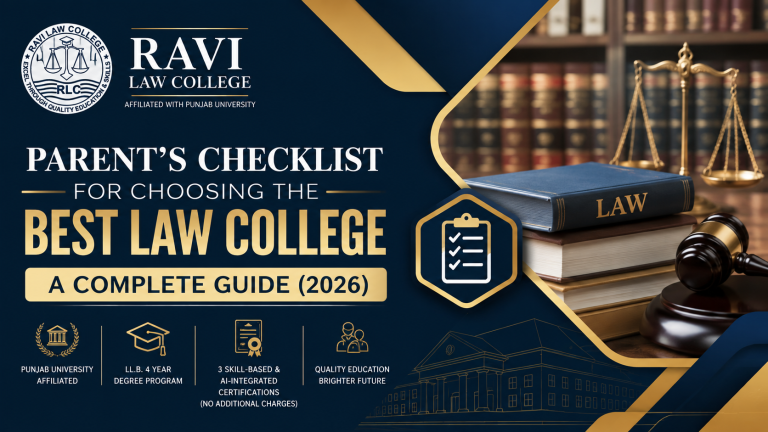
For students looking for quality legal education, Ravi Law College is among the best law colleges to consider. Ravi Law College offers an LL.B. 4-year Degree with 3 Skill-based & AI-integrated Certifications at No Additional Charges, helping students develop relevant skills alongside their legal education. Ravi Law College is also affiliated with Punjab University, making it a noteworthy option for students seeking a modern, skill-focused legal education in Lahore.